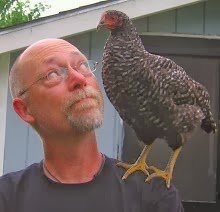
When I started this blog, I really wanted it to be about the broadfork. So far it's been about pears, intermodal logistics, chickens, and Chernobyl. Today, I'm going to talk a little bit about the broadfork.
I want you to know that I make each one by hand, one at a time in my shop. I pay attention to details during this process to make sure that each tool is as good as it can be. I go to great lengths to insure that things are done the right way, ultimately for you, but also for me and for all of us. By that I mean that I am very careful in the manufacturing process to think about the details that will make this tool useful, durable, repairable, environmentally reasonable to produce, and actually profitable, so that I can make a living by doing this. With proper care, the Gulland Broadfork should never get to the point to where it should end up in a landfill.
First, I want to introduce the process of fitting the handles to my broadfork. The select ash handles are really half the tool and deserve to be treated as such. My handles come from a small producer located about 30 miles from me in Tennessee who gives me the best he has to offer. He uses ash that is native to the Tennessee Valley, and the wood travels very minimally from where it is harvested to my shop. Mike runs a 4 person operation, and most of his employees are family members. I consider him a partner in my business, and I have the utmost respect for what he does. It has been an absolute pleasure to work with him.
I start by matching each pair of handles by grain density so both will have about the same amount of 'spring' which is what gives my broadfork such a great feel when in use. Some handled tools feel like pry bars, but these contoured ash handles have a dynamic feel when in use. All the handles are straight grained, and the grain runs the full length of the handle with no run-outs. I drill each one with the hole in line with the strongest orientation of the grain.

The drilled hole is carefully whittled out before the final handle sizing is done.
The steel handle sockets are seamless DOM tubing, and are sized just a bit smaller than the handles I get from Mike. The wood comes to me at 1.5" diameter, and the tube is 1.482" inside diameter. That leaves me with a little fitting to do as you can see from the scratches on the end of the wood handle shown here. I choose to do it this way to insure that the handle and socket are fitted very closely to each other. The wood changes size ever so slightly with changes in moisture, so it can never be perfect, but I like it to be as close as possible when it leaves my shop. The first step in sizing the handle is to see approximately how much wood needs to be removed. The handle is pressed by hand into the socket, and the resulting line gives me the exact depth of cut I need.

The sizing process is one I have decided to do the hard way. In the first few broadforks I made, I used a sander to size the handles to fit the sockets. For production, I wanted to minimize the amount of 'consumables' I had to purchase and throw away. Sanding discs wear out quickly on the rock-hard ash wood, and all that sandpaper would just go to the landfill, so I decided to buy a hand tool to do the job. I went straight to the top, and bought a bronze Lie-Neilsen low angle block plane. I'd like to thank my brother for turning me on to this exceptional tool. After I borrowed his, I went out and got one for myself. It is a joy to use, and though it may be a bit slower to use than a power sander, it works beautifully, and at a human pace. It's silent, doesn't create that fine dust that gets everywhere, and has no throw away 'consumables'. By doing it this way, I don't have to use electricity for a sander or for a vacuum system. Clean up is simple with a broom and a dustpan and I use the shavings to make fire starters and garden mulch.
I set up a simple jig to rotate the handle as I size it to fit, from time to time checking the handle socket as I slide the razor sharp blade through the wood pulling off paper thin curls. Doing this for an hour or two is quite relaxing, really, and I am always amazed at how much time passes while I am doing this very pleasant task. Yesterday I enjoyed Holst's 'Hammersmith' while I fitted a couple dozen handles. You can get much worse work.

The last step in fitting is to actually line up the holes in the wood with the holes in the metal. This is a nice, tight fit and everything lines up perfectly. The square punched hole in the handle socket is another detail I add. The handle is attached to the broadfork with a single stainless steel carriage bolt with a thin locking jam nut. The square hot punched hole holds the square shank of the carriage bolt making the fit-up as neat and clean as possible.

We're not through with the handles yet. Next time we'll take a look at the last step in making the handles as good as they can be. If you couldn't tell, I just love these tool handles. Having been a blacksmith for all these years, I feel like I am learning something new with this exposure to woodworking, and I'm looking forward to doing more of it.
Thanks for reading along, and check back soon for more broadfork information.
 We live about 10 miles from the nearest fast food blight, and refuse to eat that way anyhow. Within 2-3 miles we have a few locally owned taverns that I would feel better about supporting, but there's an issue with my arteries and a threatened early shut-down if I eat in such a way. That leaves me with a do it yourself attitude about food.
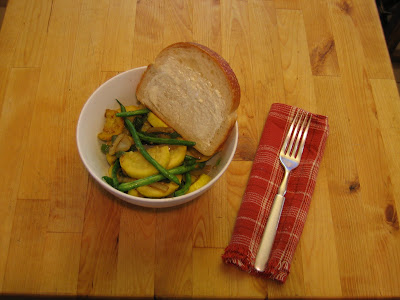 Since the world headquarters of Gulland Forge Broadforks is located here at home, we eat in a lot. In fact, we rarely eat anywhere but here, and especially this time of year. It's so easy to go and pick up our meals in the yard.
  Since the world headquarters of Gulland Forge Broadforks is located here at home, we eat in a lot. In fact, we rarely eat anywhere but here, and especially this time of year. It's so easy to go and pick up our meals in the yard.